
Although there is a plethora of views on the impact of artificial intelligence (AI) ranging from hostility and scepticism to adoration, there is probably wide agreement that AI is transformative for humans. How exactly does AI transform our society, our civilization? Is there any framework for structuring our thinking and analysis on AI’s transformative impact on us?
Technological Revolutions
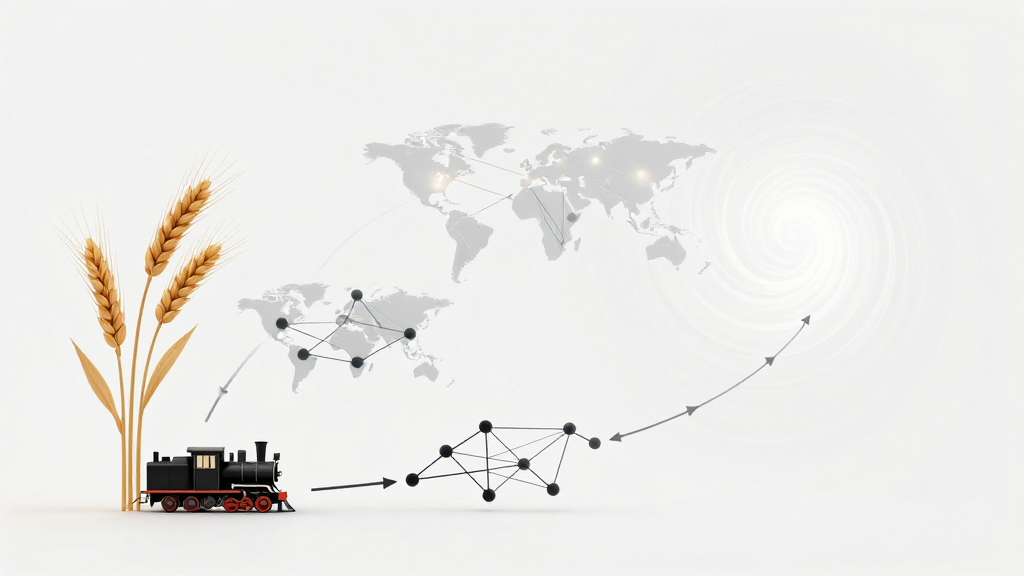
We could start by considering the epochal technological revolutions that have steered history. The Agricultural Revolution was the first, some 10,000 years ago, followed by the Industrial Revolution (around late 1700s to 1800s) and then the Information/Communications (Infocomm) Revolution starting around the 1980s. (We shall consider the information and communications technologies together for brevity).
Phase Transitions
Each of these marked a phase transition in civilization triggered by the invention of a technology that resulted in a marked increase in the quantity and/or availability of a resource, which led to a surge in production, which then supported rapid growth in whatever the resource and production enabled. In turn, that opened up unprecedented numbers of adjacent possibles that sparked virtuous cycles of mutually-reinforcing further innovations. As societies evolved to adapt to, and exploit, these technologies, they were radically re-organized, almost always towards more complexity.
The Agricultural Revolution’s signature was an increase in food production, which led to population expansion, which sparked the development of settlements (villages, towns, cities) and organized society, which led to specialization, which led to, among others, the invention of writing and the wheel, which enabled the codification, retention and dissemination of knowledge, and sparked numerous inventions in a panoply of industries.
The Industrial Revolution’s contribution was an increase in the availability of energy and power enabled by fossil fuels harnessed first through steam and then electricity, which led to dazzling productivity gains in manufacturing. Lighting, electromagnetism and refrigeration (and famously, air-conditioning, as espoused by Singapore’s founder, Lee Kuan Yew) – among other inventions – further enabled another epochal flourishing of adjacent possibles, such as skyscrapers enabled by elevators. Before elevators, tall towers were effectively prisons, as Rapunzel would attest.
The Infocomm Revolution was triggered by a surge in the amount of information made available, the means to manipulate this information (the spreadsheet is a poster child for this) and a vast increase in the ability to communicate information across distances at speed. By now it is obvious that the Internet is a resultant adjacent possible that in turn enabled just-in-time inventories across geography, cloud computing and the mobile phone among others. Less obviously, machine learning and AI are adjacent possibles made possible by the Infocomm Revolution.
Knowledge and Cognition
We’re now in the AI Revolution, whose trigger is a sudden increase in the availability of knowledge and cognition, along the progression of the data-information-knowledge-wisdom hierarchy that first started with the InfoComm Revolution. The AI Revolution supplied, in rapid sequence, two resources that became widely available. Let’s think a bit harder about the implications of each, beginning with knowledge.
Anyone with access to a large language model (LLM) already knows that AI essentially synthesizes data and information into instant knowledge at his fingertips, give and take some confabulation. The practical effect is to extend an individual’s knowledge base rapidly for wide ranges of cognitive tasks that previously would either have been impossible to achieve or require much longer times to execute or master. The productivity effects are visible all around us.
Cognition (which here means the emergent ability of AI models to reason) further enhanced the synthesis of knowledge from information. More significantly, AI models also gained the ability to also act on this knowledge autonomously. These actions can be digital (vibe coding, agentic retrieval, agentic orchestration etc…) or physical (robotics, autonomous transport etc…).

More Emergent Properties
Modern AI models are not restricted to language models: multimodal models are able to interpret and process other unstructured data such as images, video and audio. This means their cognitive abilities are not restricted to ‘next word prediction’. Vision and hearing are just another ‘language’ among the many written languages they have been trained on. Just like with language, how AI models interpret and learn from images, video and audio and other input signals/data is, as yet, largely unexplained.
Further, another emergent property of AI models seems to be the ability not only act, but also to self-improve autonomously, as demonstrated by many reasoning models. This creates multiple complications for us trying to track AI’s transformations. At a practical level, we don’t know how to predict what self-improvements will emerge autonomously. At a governance level, these self-improvements present ethical and legal conundrums, which are the subject of much work in AI safety.
In summary, we can say that a major mechanism of the civilizational phase transition that AI will enable will be through commoditized knowledge and cognition, the ability to act autonomously on these, and the ability to autonomously improve. Will these three new powers, knowledge, cognition and self-improvement, also mutually reinforce one another? Very likely so.
General-Purpose Technologies
Another aspect of thinking about the impact of AI is through the lens of General Purpose Technologies (GPTs), which are technologies so versatile that they can be deployed widely across disparate industry sectors. Two other characteristics of GPTs are that they improve rapidly, and they spawn innovation widely by increasing the opportunities for adjacent possibles that make sense only if the GPT exists. Think electricity, for instance: it is ubiquitous and led to innumerable inventions that changed the world. The transistor, and therefore, the digital age, would not have existed without it. Through a virtuous-cycle innovation feedback loop, that improves the GPT itself, which further enhances the complementary technologies (such as AI embedded in smartphones) and induces further innovation. AI is widely recognized to exhibit the characteristics of GPTs: pervasiveness, continuing technical improvements and innovation spawning (the Bresnahan-Trajtenberg framework).
Putting It All Together
So here we now have the first part of the framework:
- A sudden increase in the quantity and availability of two resources: knowledge and cognition, in a technology that is capable of autonomous self-improvement.
- The technology is also a GPT deployable across wide swathes of the economy, in combination with complementary technologies and thus triggering a proliferation of innovation.
What is left now is to consider the possible mechanisms through which these two factors impact us, our organizations, our societies, and our nations through our work. I focus on work because that’s where changes eventually end up. Somebody’s leisure is very likely to be another’s work. At a macro level, you’ve heard and read endless and breathless discussions about job displacements, organizational remodelling, governance and safety etc…. For a more fundamental level, and with a sense of irony, I consulted Anthropic’s Claude Sonnet 4.5 on mechanisms through which AI impact work. Claude came up with these interesting “diagnostic questions” towards the end of its output:
- Effects on Individuals
- Task decomposition – at a task level (a job comprises many constituent tasks) which tasks are AI-susceptible?
- Roles – for each task, does AI substitute, complement or collaborate?
- Skills implications – deskill, reskill or upskill?
- Organizational Effects:
- How must workflows and organizational structure adapt?
- Market Dynamics:
- Labor – displacement or creation?
- Productivity gains? Cost reductions? Barrier reduction? Or advantages of scale?
- Concentrating or fragmenting markets?Geographic redistribution?Creation of new markets?
- Value distribution – who captures the gains (productivity, financial, resources)?
- Temporal Impact – How does the timing and pace of work change?
I find these diagnostic questions a useful framework in thinking about how AI transforms us. There could be more mechanisms that Claude has not come up with. And there are probably hundreds of intricate management-consultancy frameworks, some of which may actually make sense for the lay public. Do leave a comment if you know of any that you find useful.
Leave a Reply