The Massive Text Embedding Benchmark (MTEB) is the de facto standard for comparing embedding models. Released in 2022, it evaluates models across eight NLP task types — retrieval, semantic similarity, classification, clustering, reranking, pair classification, summarisation, and bitext mining – spanning 56 datasets. Models are scored on each task and ranked by overall mean, producing the MTEB leaderboard that has become the go-to reference for model selection. A multilingual successor, MMTEB, has since extended coverage to 130 tasks across 250 languages.
So which embedding model should you choose for healthcare? The answer depends on what you’re trying to do – find similar clinical notes, retrieve relevant passages from a corpus, or classify sentences by topic. I looked at 6 models chosen for the diversity in their pre-training, and ran them on some of the medical domain datasets of MTEB.
The Evaluation Tasks
The five tasks cover three evaluation categories. BIOSSES (Biomedical Semantic Similarity Estimation) measures how well a model’s cosine similarity scores correlate with human judgements of sentence-pair similarity, using biomedical sentence pairs drawn from PubMed; it is the benchmark for Meaning-targeted models. NFCorpus and MedicalQARetrieval and PublicHealthQA are retrieval tasks: given a query, how highly does the model rank the relevant passages? NFCorpus uses consumer health queries against medical abstracts; MedicalQARetrieval pairs clinical questions with answers; PublicHealthQA tests retrieval of public health information and, as it turns out, doubles as a proxy for instruction-following capability. MedrxivClusteringS2S.v2 asks the model to group abstracts from the medRxiv preprint server by topic — a clustering task that probes whether the embedding space carves biomedical subject matter at its joints. Together, the five tasks span similarity, retrieval, and clustering, which is why they expose Target-axis mismatches so clearly: a model tuned for one task type will leave fingerprints – good and bad – across all three.
The Six Contenders
Two of the six models come with MTEB leaderboard rankings on the general benchmark. F2LLM-v2-14B sits at #11 on the MTEB leaderboard. It’s a large decoder-based model fine-tuned for universal embeddings – the kind that can handle retrieval, similarity, and classification within a single model by varying the instruction prefix at inference time. gte-Qwen2-1.5B ranks #4. Despite being much smaller than F2LLM, it achieved its leaderboard position through aggressive instruction-tuned retrieval training.
The remaining four are not on the MTEB general leaderboard. MiniLM is a compact general-purpose encoder trained on natural language inference pairs – I used it as the baseline because it’s widely deployed, fast, and serves as a sensible reference point. BioLORD is a domain-specific model trained on UMLS ontology relationships: it learned that “myocardial infarction” and “heart attack” should be geometrically close by processing thousands of UMLS concept-similarity pairs, rather than raw text. BioClinical-ModernBERT is a clinical domain encoder pre-trained on biomedical and clinical text and capable of processing up to 8192 tokens – a comfortable context window for most clinical texts. EmbeddingGemma is Google’s Gemma-based embedding model, trained as a general-purpose semantic model. I used the medically-tuned version of it.
Results
The results are in the heatmap below:
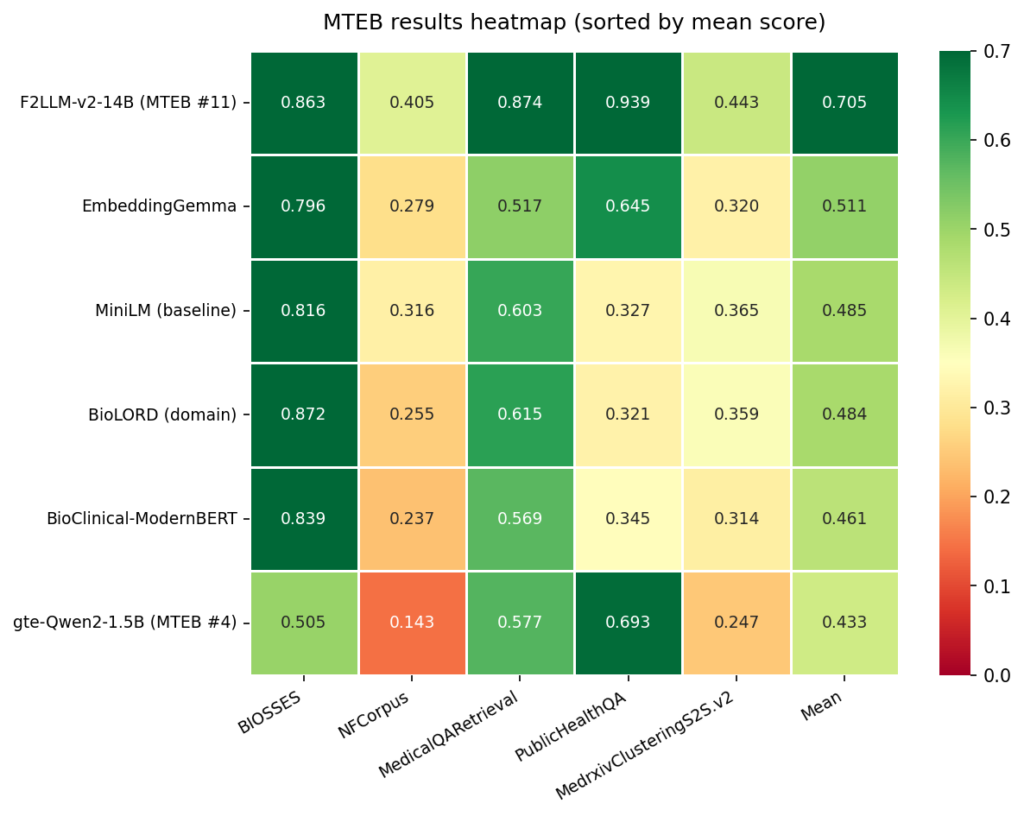
The heatmap is sorted by mean MTEB score, which puts F2LLM at the top (0.705) and gte-Qwen2 at the bottom (0.433). But the mean is almost the worst statistic to look at here, and the heatmap makes that visible at a glance.
Consider BioLORD and MiniLM. Their mean scores are 0.484 and 0.485 – essentially identical. But their task profiles are mirror images of each other. BioLORD leads on BIOSSES (0.872), which measures semantic similarity between biomedical sentence pairs: exactly the task its UMLS training prepared it for. Then it drops off steeply on every retrieval task. MiniLM is the reverse – modest on BIOSSES, much more consistent across retrieval. Same mean score, completely different models for completely different use cases. If you selected either of these on mean score alone, you’d have a coin flip’s chance of picking the right one.
The gte-Qwen2 story is interesting. Despite being MTEB #4, its BIOSSES score collapses to 0.505 — barely above chance for a similarity task. Why? Because its training was so heavily oriented toward asymmetric retrieval (matching a short query to a long passage) that the geometry it learned is the wrong shape for symmetric similarity (matching two sentences of roughly equal length and register). It’s the model equivalent of a sprinter who can’t run a marathon: the training optimised for one thing and actively degraded performance on another.
PublicHealthQA tells yet another story. The encoder models – MiniLM, BioLORD, BioClinical-ModernBERT – all cluster between 0.32 and 0.35. The decoder-based models score 0.645 to 0.939. This task requires instruction-following, and encoder models, regardless of domain, simply weren’t built for it. Domain specialisation doesn’t help you here; architecture does.
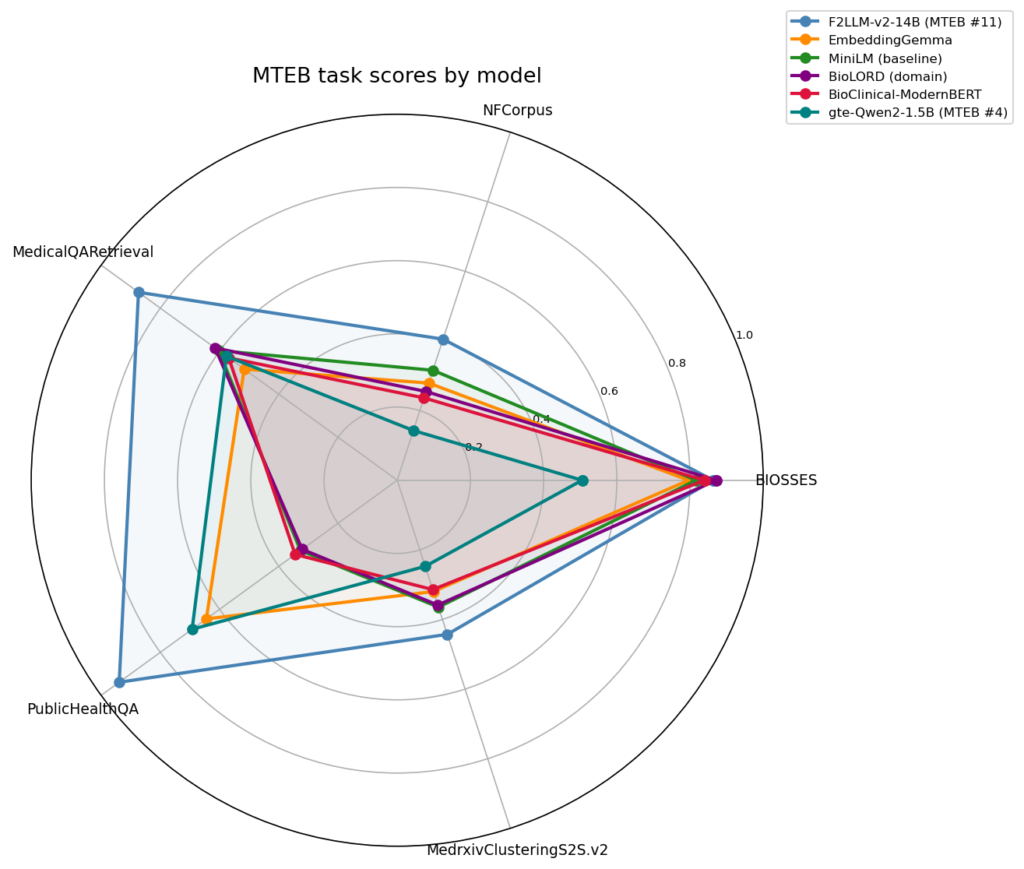
The radar chart makes the shape of each model’s performance visible in a way the heatmap can’t. F2LLM’s polygon overshadows the rest on all tasks — the signature of a well-balanced model. BioLORD has a strong BIOSSES vertex but thin retrieval arms. These shapes map directly onto the Target axis: Meaning-targeted models are round on similarity but flat on retrieval; Task-targeted retrieval models invert that.
I also did an internal intrinsic evaluation (anisotropy and uniformity), clinical semantic textual similarity (STS) checks, and classification checks (classification, for some reason, isn’t in MTEB’s medical domain tasks) using the Hallmarks of Cancer dataset on the models (might write about these in a later post…). A few findings from that suite are worth flagging here. BioClinical-ModernBERT led the HOC classification probe despite trailing in retrieval, because its pre-training on clinical full-text gives it a richer feature space for topic separation tasks. On TREC-COVID, a BIOSSES subset built on long abstracts, BioClinical-ModernBERT topped the leaderboard – the 2,048-token context meant it read entire abstracts while other models were truncating. Context length is a first-class variable for clinical text, where discharge summaries and operative notes routinely run long.
The Inconvenient Conclusion About Domain Models
The domain models – BioLORD and BioClinical-ModernBERT – were trained with the intention of capturing biomedical and clinical knowledge. And they do, in their respective niches. But the benchmarks show that the gap between a large well-trained general model (F2LLM) and a domain-specific one is wide across most tasks. Domain adaptation alone is not a reliable substitute for scale and instruction-tuning diversity. The question isn’t whether BioLORD knows more clinical vocabulary than MiniLM (it does), but whether that knowledge is expressed in a geometric form that’s useful for your specific task. Often it isn’t.
My Picks: General and Edge
If I had to choose two models for a healthcare deployment – one for a well-resourced server environment, one for a constrained edge setting – here’s where I land.
For general use, F2LLM-v2-14B is the clear choice. It’s the only model that performs well across all task types without a catastrophic collapse in any of them. Its size (14B parameters) is the cost, but if you’re running server-side inference for a clinical NLP pipeline, that’s manageable.
For edge deployment – an on-premise hospital server, a workstation, or a resource-limited inference environment – I’d pick BioClinical-ModernBERT. Its 8192-token context is clinically relevant: clinical notes are not short, and truncating them loses information that matters. It topped TREC-COVID retrieval, led the HOC classification probe, and carries genuine domain pre-training. It won’t win on every benchmark, but it’s purpose-built for the kind of text that actually shows up in healthcare settings, and it runs on modest hardware. It’s weakness is in retrieval, where the general models outperform it.
MiniLM is an honourable mention if you’re genuinely GPU-poor – it’s the smallest model here and punches above its weight as a general baseline.
The broader lesson: benchmark on your actual tasks. MTEB mean scores are a reasonable starting point for general model discovery, but as these results show, a model ranked #4 globally can collapse on a specific task type while a domain-specific model that never appears on the leaderboard outperforms everything on another.
(This post was written with Claude Sonnet 4.6’s help.)
Leave a Reply